

‘Key Selling Point’ Modules
How can we create a scalable component framework that increases product distinction and flexible storytelling?
My Role
UX Design lead working with Product, Engineering, Marketing, Creative, and Publishing teams
Project Scope
3 months
Skills used
UX Strategy, Design thinking, Program management, Competitive auditing, Usability and heuristic analysis, User interviews, User validation, Insight synthesis, Wireframing, Prototyping, Requirement creation, Workflow optimization, Cross functional collaboration
Introduction
I was asked to design the second version of the KSP module, the primary content used to educate users about product features on Google Store Product Detail pages. The PDP acts as the source of truth for a product’s core information, and is the key user touch point for product education, consideration, and conversion. The KSP module is integral to persuading customers to move down the purchase funnel and hopefully convert.
Key context
No brief or requirements
I had just spent a 1-month sprint working to concept and launch the first version of the KSP module
Competing page build philosophies between Creative and Engineering: Reusable vs Non-reusable components
Discovery
In the absence of formal requirements, I conducted an extensive Discovery phase to understand underlying problems that may exist with the KSP module - research I did not have time to do for the first version. Many of the activities, included Internal product audits, Competitive audits, Heuristic Analysis, Data retrieval and research, Stakeholder Interviews, and Insight Distillation.
Key Insights
💡 Users want specific and practical product information
💡 Users are more inclined to purchase if they can differentiate products
💡 Stakeholders need more template options with better documentation and guidelines
💡 Products have different storytelling needs in order to effectively sell the use case and feature narratives
💡 There are benefits and drawbacks to both reusable and non-reusable modules, but both may be needed in order to effectively market the product
💡 A reusable module will inherently have limitations in creative execution
💡 Page components built today should be scaling toward future page and product use cases
Solution Brainstorming
How might we … make product education more meaningful, relatable, and useful to customers?
How might we … increase product distinction amongst products within the Google Store catalog?
How might we … build pages so that a product story is effectively told using the least amount of resources?
How might we … build pages so they’re scaled for future page and product use cases?
Near-term KSP module requirements
Modules should possess some nature of reusability
Modules should accommodate various types of imagery, including interactive media
Prioritize vertical space and minimize necessary scrolling
Accommodate flexible creative execution to minimize visual redundancy
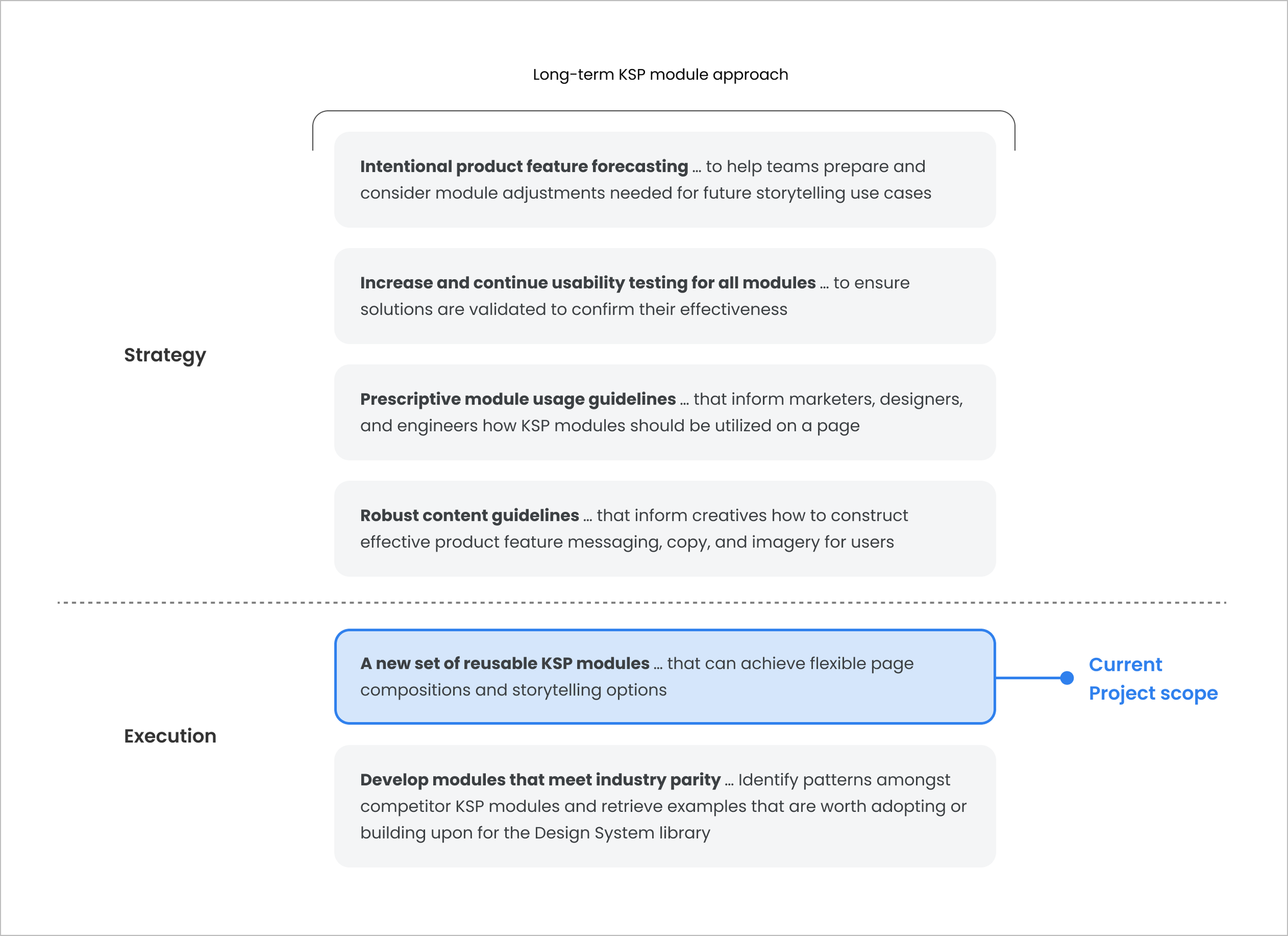
A Multi-pronged approach, solution to impactful KSP modules
Upon sharing my insights and takeaways, I worked with Product, Marketing, and Engineering teams to reach a a long-term solution to KSPs that was not limited to simply creating more modules. My findings showed that simultaneous initiatives pertaining to both strategy and execution was the most scalable solution.
Exploration
Armed with requirements, I explored ways to systematize the KSP elements and find patterns and recurring themes in hopes of identifying scalable concepts.
KSP element analysis and grouping
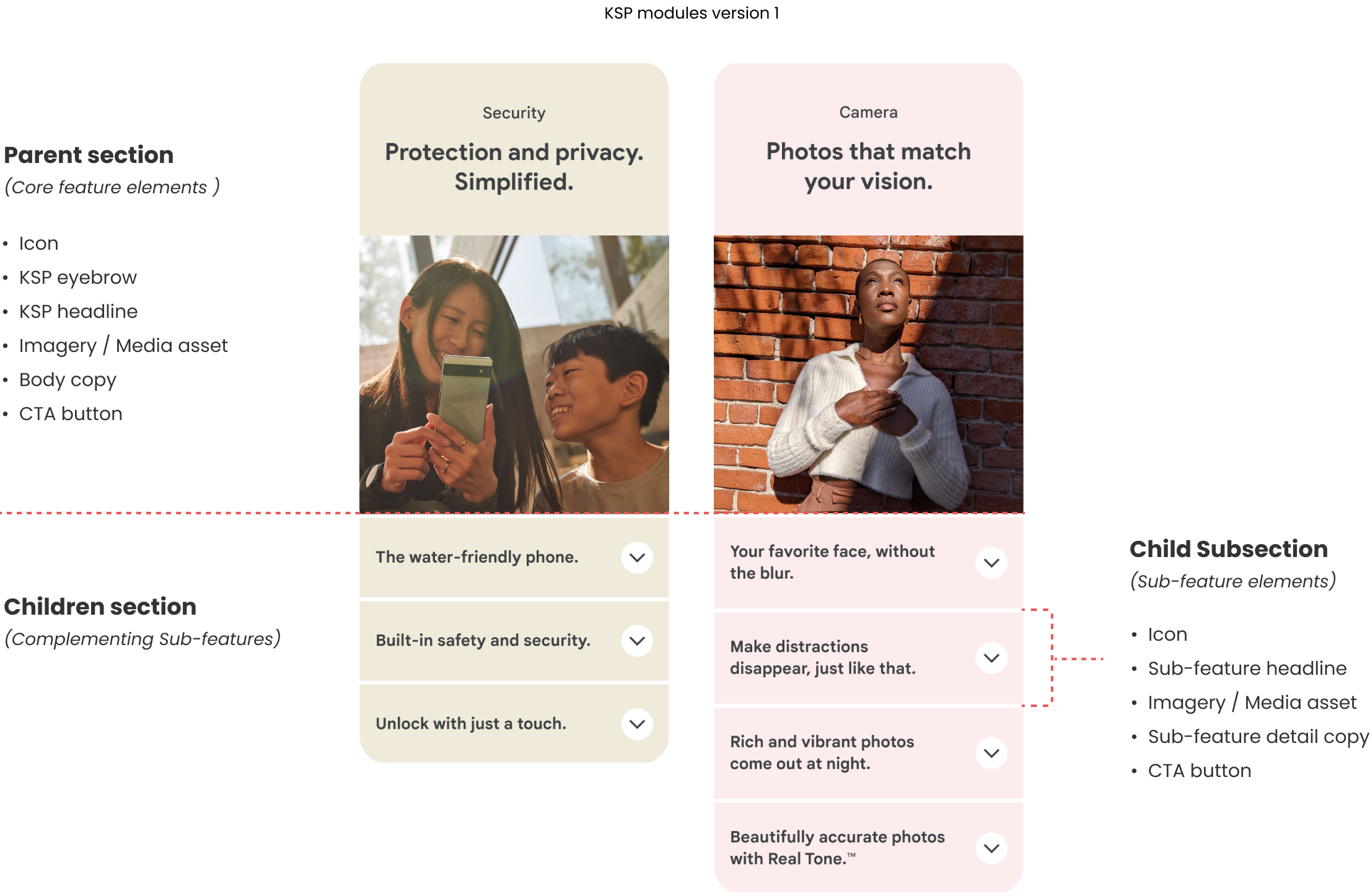
As a starting point, I took inventory of elements often used to compose KSPs so I understood what pieces could potentially be utilized in each module. I noticed that each KSP often contained elements that grouped into Primary and Secondary feature information. The Primary information pertained to core product feature content and the Secondary to sub-features that support the core feature. I chose to label these as “Parent” and “Children” sections.
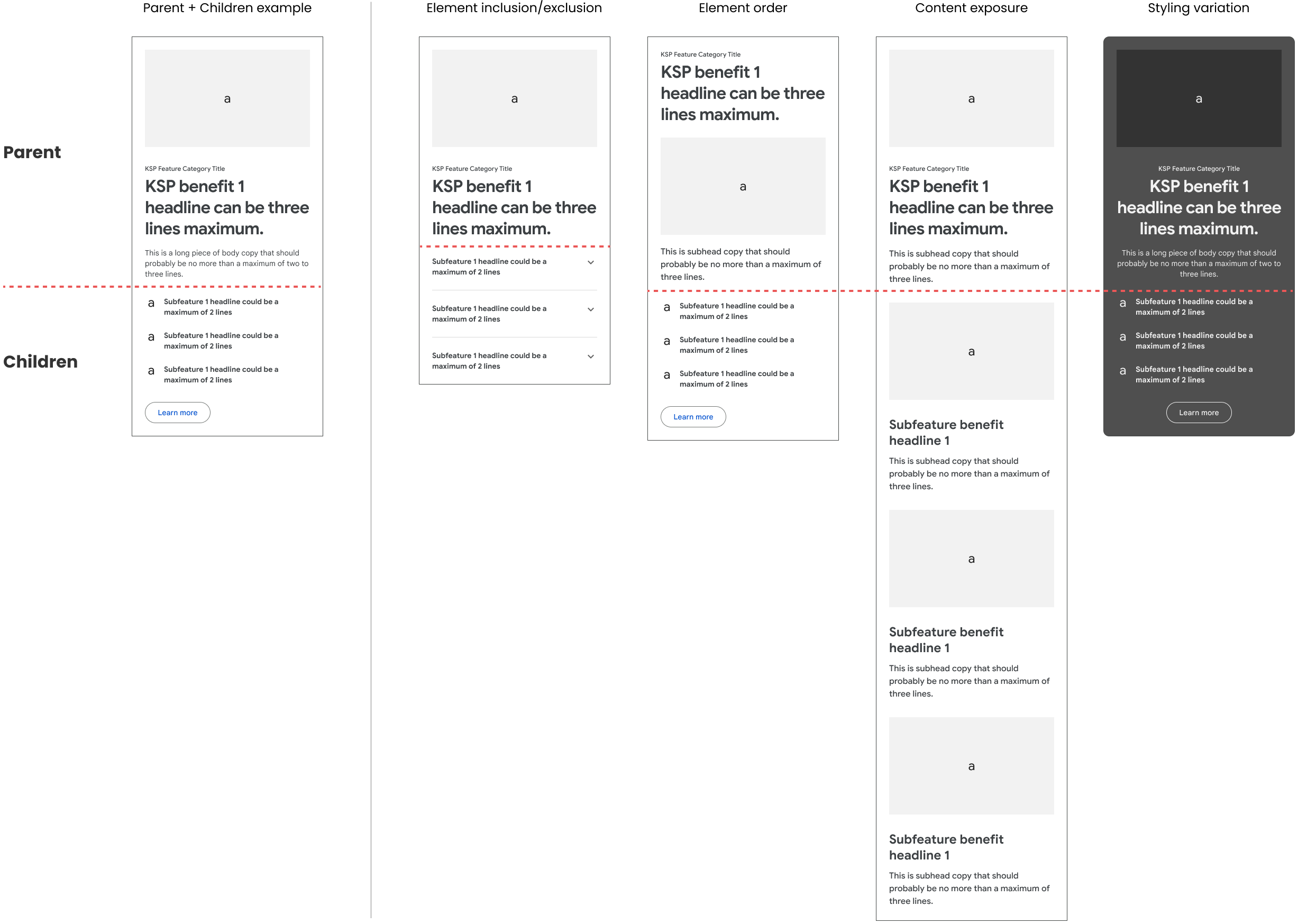
Execution strategies to promote variety, options
Although each type of section could contain a range of elements and content, it was clear that a Parent or Children could vary in appearance based on the inclusion or exclusion of elements, styling, the pairing of different types of Parents and Children, and controlling the amount of content immediately visible to the user.
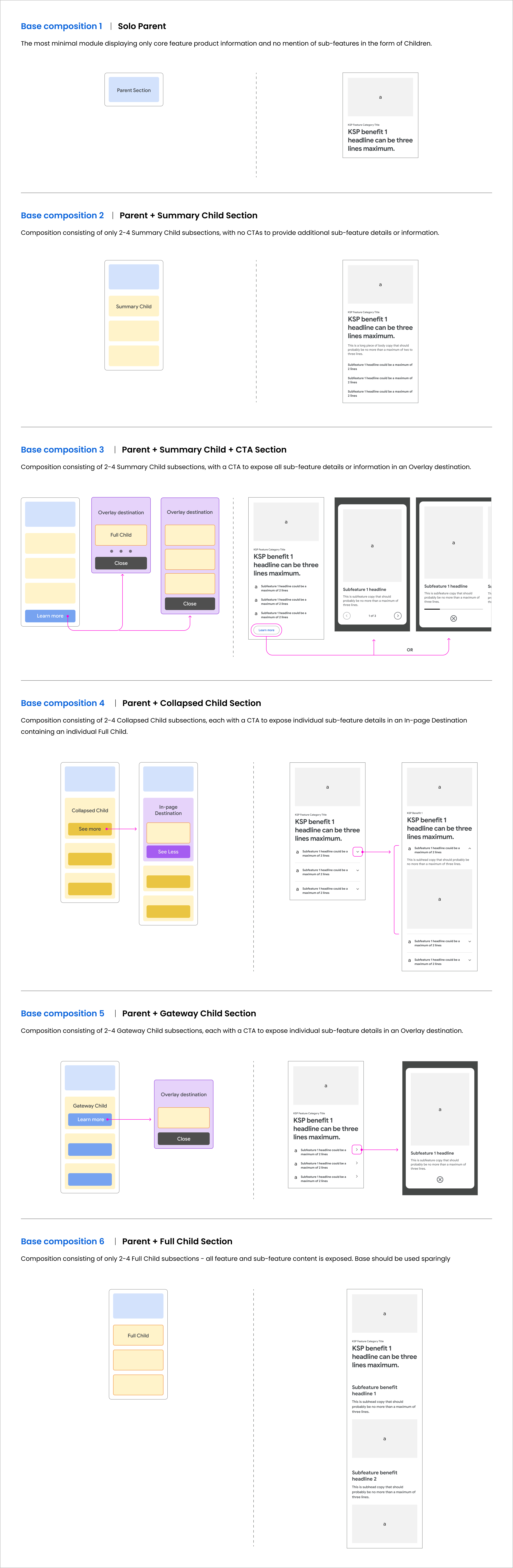
Foundational section combinations
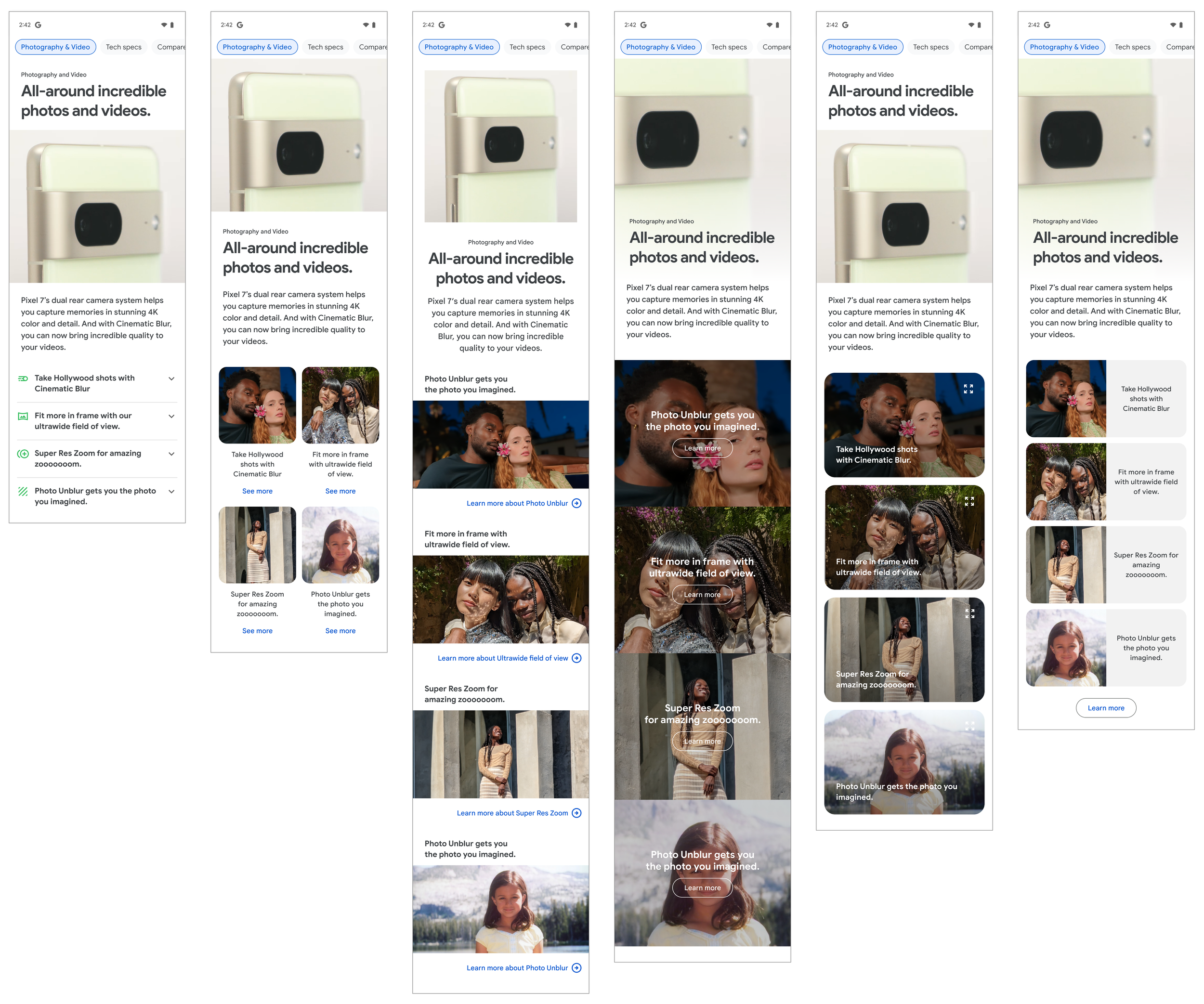
These levers became the launching point for conceptual iterations, now that I knew the elements to consider and the factors that could manipulate their perception to the user. I landed on 6 foundational KSP module compositions (bases), comprised of different Parent and Children section combinations.
Solution
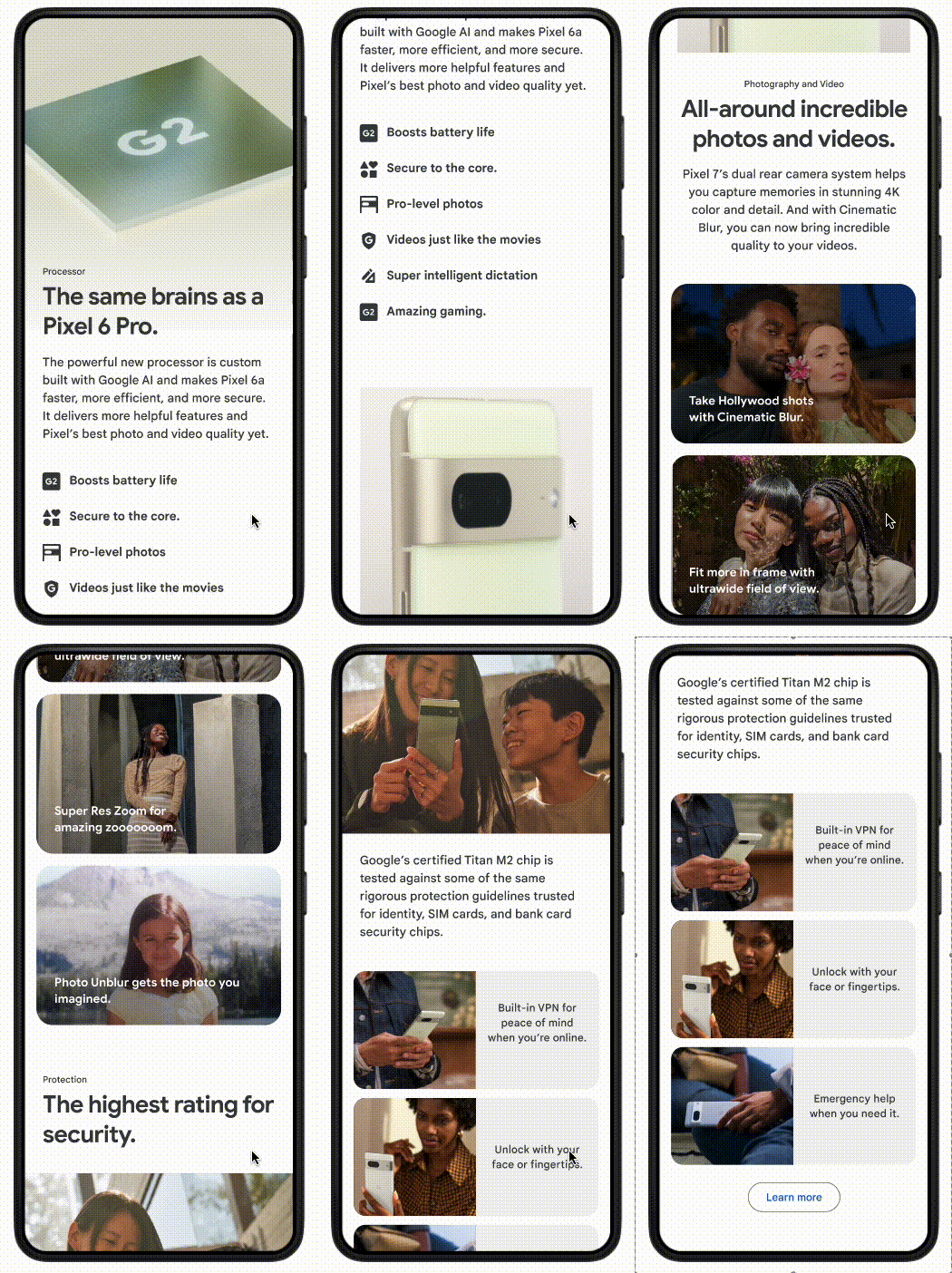
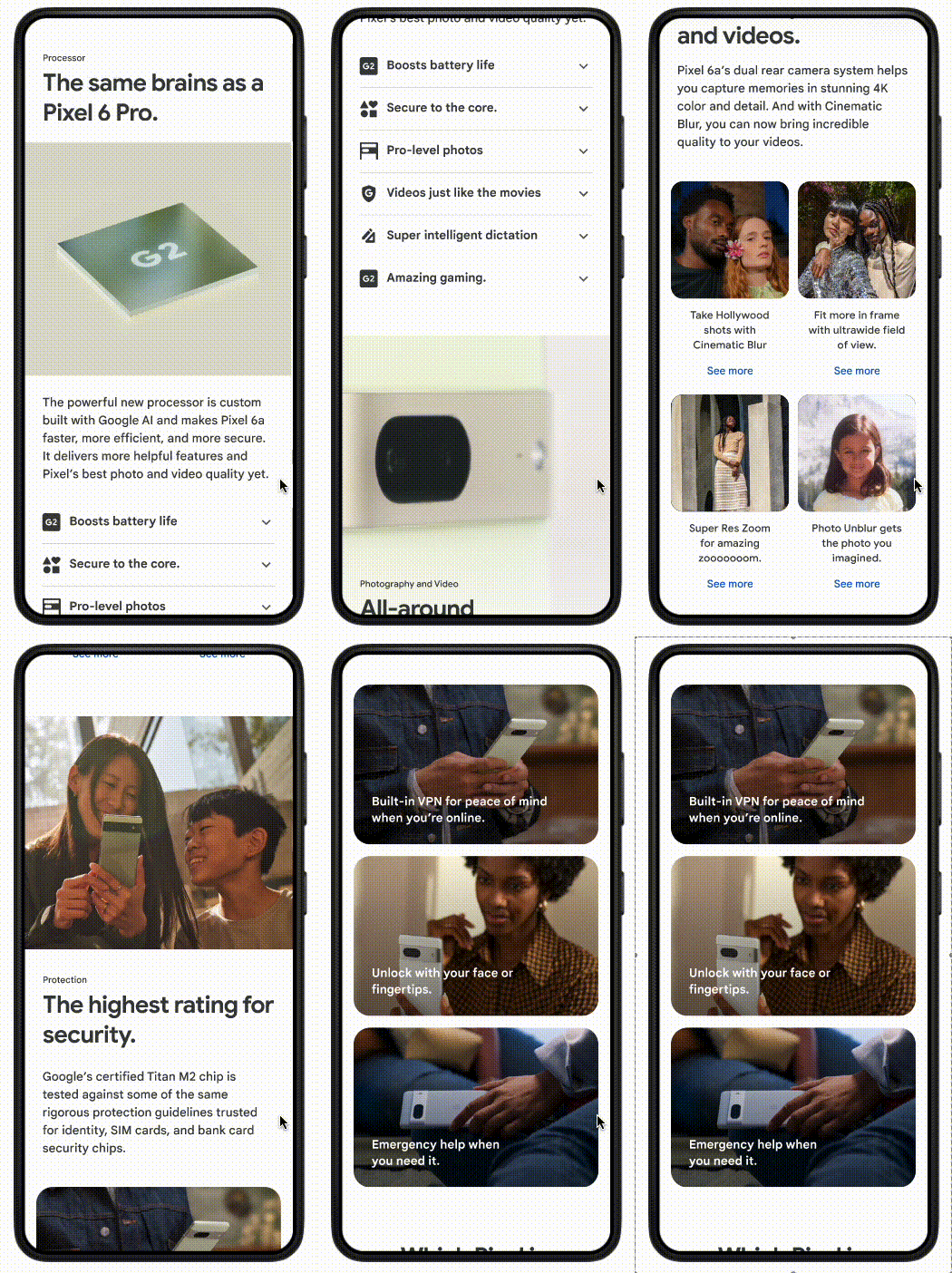
In combining different iterations of each base composition, the pages, in total, achieve a great amount of visual variation and differentiation, key objectives and requirements. Below are examples of how the same KSP content could appear, utilizing differing base compositions.


Result
This solution garnered excitement from many of our stakeholders given the current amount of resources dedicated to conveying KSPs. But, because a solution like this required alot of coordination, the fruits would not be evident for at least another year.
Given the trajectory of it’s impact, program managers estimated a significant reduction in engineering and overall marketing efforts by the end of 2024.
Next steps
Largest issues in development:
Stress-testing the scalability of the system
Build timelines for eventual delivery
System terminology
Parallel desktop iterations
Base module concepts
Content guidelines and scope
Module usage rules and guidance
KSP tier methodology
Reusable motion property scope and feasibility
Visual design
Creative asset considerations